A reliable clothing manufacturer should be able to explain how your garments will be made, produce a sample that meets your specifications, and put pricing, quality requirements and delivery terms in writing. Start with manufacturers experienced in your product category, verify their business and production facilities, compare samples against the same brief, and place a manageable first order before scaling up.
This guide is for fashion brands sourcing custom dresses, T-shirts and hoodies. It covers what to ask before choosing a factory and how to evaluate the answers.
1. Prepare a clear product brief before contacting factories
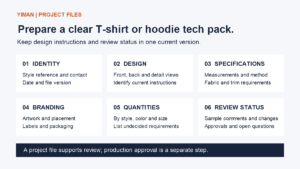
A factory cannot give a useful quotation from a reference photo alone. Share the information below so each supplier quotes a comparable product.
- Product category, design drawings or reference photos.
- Fabric composition, fabric weight and desired finish, if known.
- Measurements, size range and quantity by size.
- Number of designs, colors and pieces per color.
- Prints, embroidery, labels and packaging requirements.
- Delivery destination and required delivery date.
If you do not have a technical pack, ask whether the supplier can help develop one and what that service costs. Confirm who owns the resulting patterns and files. A written brief reduces ambiguity; it does not replace sample approval.
2. Choose a manufacturer with relevant garment experience
Ask to see samples similar to your planned collection. A broad product catalog is less useful than evidence that the team understands your fabric, fit and construction requirements.
| Product | What to check in the sample | Questions to ask |
|---|---|---|
| Dresses | Fit, lining, zipper operation, seam finish and fabric drape | How will you control fit across sizes and handle delicate or sheer fabrics? |
| T-shirts | Fabric weight, neckline recovery, shrinkage and print finish | What fabric options are available, and how will the garment be checked after washing? |
| Hoodies | Fabric weight, rib recovery, hood shape, pocket construction and decoration | Can you match the requested silhouette and explain the printing or embroidery limitations? |
3. Verify the business and understand where production happens
Request the supplier’s registered company name, business registration details and production address. Check that quotation and payment documents identify the business you intend to work with. If another company receives payment, request an explanation and supporting documentation before proceeding.
Ask for a live video walkthrough of the relevant production areas, or arrange a visit or independent audit when appropriate. Photos can provide context, but they do not establish ownership of a facility or prove that your order will be made there.
Clarify which processes happen in-house and which are subcontracted. Printing, embroidery or specialist treatments may be handled by another supplier. What matters is knowing who controls those steps and who is responsible for quality and delays.
4. Understand the MOQ before comparing prices
A minimum order quantity may apply per design, per color, per fabric or to the entire order. Ask for the exact rule and whether mixed sizes are allowed. Also check whether custom fabric, printing or trims have separate minimums.
Example: an MOQ of 50 pieces per design, per color means that one T-shirt design in two colors requires at least 100 pieces. Three designs in two colors each require at least 300 pieces. Mixed sizes allow you to distribute the required quantity across sizes; they do not remove the design or color minimum.
Choose a quantity you can reasonably test with customers. A low MOQ can make a first order more manageable, but evaluate it alongside sample quality, unit cost and reorder conditions.
5. Order a sample and approve measurable requirements
Check the sample against your brief rather than relying on whether it looks attractive in a photo. Record measurements, inspect seams and decoration, assess fit, and check care performance using an agreed method. Where formal testing is needed, agree on the test method and acceptance criteria with a suitable testing provider.
- Confirm fabric composition, weight, color and feel.
- Check measurements and agree acceptable tolerances.
- Review stitching, trims, labels, print placement and packaging.
- Document revisions with clear photos and written comments.
- Keep an approved reference sample and a final specification sheet.
Ask whether the sample uses the intended bulk fabric and trims. If substitutes are used, identify them explicitly and approve the final materials before bulk production.
6. Compare complete quotations, not just unit prices
Use the same specification and quantities when requesting quotes. Confirm which costs are included and which are separate: sampling, pattern development, fabric, decoration, labels, packaging, inspections and freight.
Ask for the currency, quote validity, payment milestones and delivery terms. Identify who is responsible for transport, insurance, import clearance and destination charges. A lower garment price can be less attractive once excluded services and shipping costs are added.
7. Agree on production timing and quality checks
Separate sample development time, bulk production time and shipping time. Ask what starts the production clock: deposit receipt, approved samples, confirmed specifications or material availability. Put the agreed sequence in writing and include time for revisions.
Ask how the factory checks incoming materials, work in progress and finished garments. Agree how defects will be classified, how inspection results will be shared and what happens if the order does not meet the approved requirements. If you plan an independent pre-shipment inspection, arrange access and timing before production starts.
8. Use a manageable first order to evaluate cooperation
Before committing to a large collection, start with a limited number of designs. Evaluate the finished garments alongside communication, consistency with the approved sample and the handling of issues. Keep records of actual lead times and customer feedback so your reorder decisions are based on evidence.
Warning signs worth investigating
- The supplier will not clarify its business identity or production location.
- The quotation leaves out fabric specifications, MOQ conditions or delivery terms.
- Samples differ from the agreed brief without explanation.
- The supplier pressures you to start bulk production before sample approval.
- Payment instructions change without a documented explanation.
- Certificates or customer claims are presented without verifiable details.
Any one issue needs clarification rather than an automatic conclusion. If important questions remain unanswered, pause the order and investigate before paying.
A copy-and-send factory inquiry template
Hello, we are developing a clothing collection for our brand and would like a quotation.
Product: [dress / T-shirt / hoodie]
Designs and colors: [details]
Quantity per design and color: [quantity]
Size range and size breakdown: [details]
Fabric and decoration: [requirements]
Delivery destination and target date: [details]Please confirm your MOQ, sample cost and development time, bulk production time, included services and payment terms. Please also explain your sample approval process, quality checks and any work that will be subcontracted. We can provide reference images or a technical pack.
Custom clothing manufacturing with YIMAN
YIMAN is a clothing factory based in Guangzhou, China, established in 2011. We provide OEM and ODM services for men’s and women’s fashion collections, focusing on dresses, T-shirts and hoodies. Customization options include fabrics, styles, colors, sizes and logos.
| Service detail | YIMAN’s stated terms |
|---|---|
| Minimum order quantity | 50 pieces per design, per color; mixed sizes allowed |
| Sample development | Confirmed for each project |
| Bulk production | Confirmed for each project |
| Location | Guangzhou, China |
Ask us to confirm the timing basis, material availability and schedule for your specific project. Shipping time should be confirmed separately.
Planning a collection? Send your design references, fabric requirements, quantities and destination to request a custom clothing quotation. You can also discuss your project with YIMAN on WhatsApp.
Frequently asked questions
How do I know if a clothing manufacturer is reliable?
Verify its business identity and production arrangements, evaluate a sample against written specifications, and agree on quality, payment and delivery terms. A manageable first order gives you evidence of how the supplier performs.
Should I work directly with a factory or use a sourcing company?
Either can suit a brand’s needs. A factory may offer direct production communication, while a sourcing company may coordinate several suppliers. Clarify each party’s role, fees and responsibility for quality before choosing.
Can I order different sizes within a 50-piece MOQ?
It depends on the supplier’s rules. YIMAN allows mixed sizes within its MOQ of 50 pieces per design, per color. Confirm your size breakdown when requesting a quotation.
What should I send a factory to get a quote?
Send your designs or reference images, fabric requirements, size range, quantities by design and color, decoration requirements and destination. Ask the factory to identify any missing information or assumptions in its quote.
Does sample approval guarantee identical bulk production?
A sample alone is not a guarantee. Use an approved reference sample, final specifications, agreed tolerances and production inspections to define and check the bulk order.
How long does custom clothing production take?
Sample development and bulk production schedules are confirmed for each project after reviewing the design, materials, quantities and revisions. Agree whether the schedule uses working or calendar days and what starts each period. Confirm inspections and shipping time separately before committing to a delivery date.



Add comment